
Government jobs are still a popular career choice in Pakistan. Every year, thousands of people apply for positions in federal and provincial departments, public universities, courts, hospitals, and other government organizations.
The reason is simple: government jobs can offer job security, a fixed pay scale, retirement benefits, and opportunities for career growth. However, getting a government job is not just about having the right qualification. You also need to follow the application process correctly.
A small mistake, such as submitting an incomplete form, missing a required document, paying the wrong fee, or applying after the deadline, can lead to rejection.
In this guide, we’ll explain how to apply for government jobs in Pakistan step by step, from finding a genuine vacancy to preparing for the written test and interview.
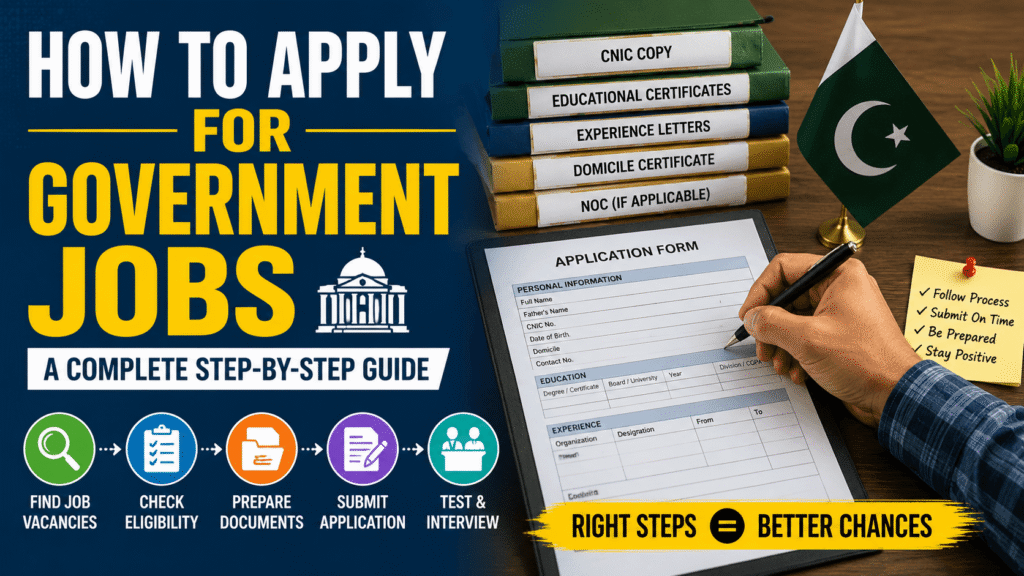
1. Find Genuine Government Job Vacancies
The first step is finding a genuine government job advertisement. There are many websites and social media pages that share job updates, but you should always verify the vacancy before applying.
Government jobs in Pakistan are commonly advertised through:
- Official newspapers such as Jang, Dawn, The News, and Express
- Official websites of government departments
- Government universities, colleges, hospitals, and public organizations
- National Job Portal (NJP)
- FPSC and provincial public service commissions
- NTS, PTS, OTS, and other testing organizations
- Official career or recruitment portals of government organizations
Job portals can be useful for discovering new vacancies, but don’t rely on an unofficial source alone. Always check the original advertisement before submitting your application.
Be especially careful with WhatsApp groups, Facebook pages, or individuals who claim they can guarantee a government job in exchange for money. No legitimate recruitment process can guarantee selection simply because someone asks for a payment.
2. Read the Job Advertisement Carefully
Once you find a vacancy that interests you, don’t rush to apply. Read the complete advertisement carefully.
Government job advertisements often contain important information in small sections or at the bottom of the notice. Missing one requirement could make you ineligible.
Before applying, check the following:
Post Title and Department
Make sure you are applying for the exact position you want. Some advertisements contain several vacancies with different qualifications and departments.
For example, an advertisement may include positions for Assistant Professor, Lecturer, Computer Operator, Clerk, and other posts. Each position may have different eligibility requirements.
Educational Qualification
Check the required degree, subject, division, CGPA, or professional qualification.
Some positions may require a specific degree rather than simply a general bachelor’s or master’s qualification.
Experience Requirements
If experience is required, carefully check:
- Number of years required
- Relevant field or department
- Whether private-sector experience is accepted
- Whether experience must be obtained after a particular qualification
Don’t assume that every type of work experience will count.
Age Limit
Check both the minimum and maximum age mentioned in the advertisement.
Some government positions offer age relaxation for eligible candidates, but the rules vary depending on the organization and type of vacancy.
Domicile
Domicile is particularly important for provincial and district-based vacancies.
The advertisement may specify that candidates must have a domicile from a particular province, district, or region. If your domicile doesn’t meet the requirement, you may not be eligible even if you have the required education.
Last Date
Finally, note the last date for submitting your application.
Also check whether the advertisement says the application must be received by the closing date or whether the postmark date is accepted. These conditions can differ from one organization to another.
3. Prepare Your Documents Before Applying
One of the easiest ways to avoid problems is to prepare your documents in advance.
Depending on the job, you may need some or all of the following:
- Updated CV or resume
- Recent passport-size photographs
- CNIC copy
- Domicile certificate
- Educational certificates
- Degree and transcript copies
- Experience certificates
- Professional registration or license, if required
- NOC (No Objection Certificate), if applicable
- Reference letters, if specifically requested
- Bank challan, pay order, or processing fee receipt
Some organizations require attested copies of certificates and documents. Others may only ask for scanned copies during the online application and request original documents later.
Always follow the requirements mentioned in the specific advertisement.
It is a good idea to keep digital copies of your important documents in a properly organized folder. This makes online applications much easier because you won’t have to search for documents every time you find a new vacancy.
4. Fill Out the Application Form Carefully
After confirming that you meet the requirements, it’s time to complete the application.
This step may seem simple, but mistakes in the application form are surprisingly common.
If you are filling out a manual form:
- Write clearly and carefully
- Use black or blue ink according to the advertisement
- Use block letters if instructed
- Don’t leave required fields blank
- Sign the form wherever required
Before submitting, check your:
- Full name
- Father’s or guardian’s name, where required
- CNIC number
- Date of birth
- Domicile
- Educational qualifications
- Experience details
- Post title
- Contact number
- Postal address
Your information should match your official documents.
Applying Online
For online applications, carefully follow the instructions on the recruitment portal.
Pay attention to:
- Photograph size
- Document format
- Maximum file size
- Required fields
- Application fee
- Application tracking number
Don’t wait until the final few hours to upload everything. If the website becomes slow or you experience an internet problem, you may not have enough time to complete the application.
5. Pay the Application Fee Correctly
Some government vacancies require an application or processing fee.
The advertisement will normally explain how and where the fee should be paid.
Depending on the organization, you may be asked to use:
- Bank challan
- Pay order
- Online payment
- Bank deposit
- Digital payment method
Make sure the fee is paid for the correct post and organization.
Keep your payment receipt or transaction record safe. If the application requires you to upload or attach proof of payment, make sure you do so correctly.
An incorrect or missing fee payment can result in your application being rejected.
6. Submit Your Application Before the Deadline
Never make the deadline your target submission time.
If you’re applying by post, try to send the application several working days before the closing date. Postal and courier delays can happen, and some organizations only consider applications that reach them before the deadline.
For online applications, submit early whenever possible.
Government recruitment websites can sometimes experience heavy traffic near the closing date. You don’t want to discover a technical problem when there are only a few minutes left.
After submitting your application, save:
- Application form
- Tracking/application number
- Fee receipt
- Submitted documents
- Courier receipt, if applicable
- Screenshot or printout of the confirmation page
Keeping these records can be useful later if you are shortlisted.
7. Prepare for the Written Test
Not every government job requires a written test, but many positions do.
Recruitment through organizations such as testing services or public service commissions may involve a written examination before candidates are shortlisted for interviews.
Start preparing as soon as you know a test is required.
Your preparation may include:
General Knowledge
Review important national and international events, Pakistan-related information, geography, history, and other general knowledge topics relevant to the test.
Current Affairs
Keep up with important national and international developments. Reading reliable news sources regularly can help.
English
Depending on the position and testing organization, questions may cover grammar, vocabulary, sentence correction, comprehension, and related topics.
General Ability
Some tests include mathematics, analytical reasoning, logical reasoning, or basic computer knowledge.
Subject-Specific Questions
For professional positions, a significant portion of the test may relate directly to your field.
For example, an IT position may include questions about programming, databases, networking, operating systems, or cybersecurity.
Practice Past Papers
Past papers are one of the most useful ways to understand the style and difficulty of a test.
Try to practice questions under a time limit rather than simply reading the answers.
8. Don’t Forget Your Roll Number Slip and CNIC
If you are called for a written test, check the instructions on your roll number slip carefully.
On test day, take the required documents with you, particularly:
- Original CNIC
- Roll number slip
- Any other item specifically mentioned by the testing organization
Try to reach the examination center early.
Arriving at the last minute can create unnecessary stress, especially if you have difficulty finding the center or there are security checks at the entrance.
9. Prepare for the Interview
Passing the written test, where applicable, is only one part of the recruitment process.
If you are shortlisted for an interview, prepare seriously.
Research the department and understand the responsibilities of the position you applied for.
You should be prepared to answer questions about:
- Your education
- Your previous experience
- Your skills
- The position you’re applying for
- The department
- Your relevant subject or profession
- Your career goals
You may also be asked general questions to understand your communication skills, confidence, and suitability for the position.
Take Your Original Documents
Carry your original educational and professional documents along with photocopies if the interview instructions require them.
The recruitment committee may verify your qualifications and experience before or during the interview process.
Dress Professionally
You don’t need an expensive outfit. A clean, simple, and professional appearance is usually enough.
Be punctual, speak respectfully, and answer questions honestly.
10. Be Honest About Your Qualifications
Never provide false information on a government job application.
If an organization asks for a particular qualification or amount of experience, make sure you actually meet the requirement.
Government organizations may verify educational qualifications, professional registrations, and employment records.
Providing incorrect information can cause serious problems, including disqualification from the recruitment process or cancellation of an appointment.
Common Mistakes to Avoid When Applying for Government Jobs
Many applicants lose opportunities because of avoidable mistakes. Here are some of the most common ones:
Applying Without Checking Eligibility
Don’t apply simply because you like the job title. First check the qualification, age, domicile, experience, and other requirements.
Missing Required Documents
Read the advertisement carefully and prepare every required document before submitting your application.
Paying the Wrong Fee
Double-check the fee amount, payment method, and organization before making the payment.
Ignoring the NOC Requirement
If you are already working in government or another public-sector organization, check whether an NOC is required.
Applying at the Last Minute
Technical issues, internet problems, banking delays, and courier problems can all cause trouble when you leave everything until the final day.
Trusting Unofficial Sources
Use job websites and social media pages to discover vacancies, but verify important information through the official advertisement or recruiting organization.
Not Keeping Proof of Submission
Save your application number, receipt, submitted form, and other relevant records until the recruitment process is completed.
Government Jobs Application Checklist
Before submitting your application, quickly go through this checklist:
- I meet the educational requirements
- I meet the age requirement
- My domicile meets the requirement
- I have the required experience
- I have prepared all required documents
- My CNIC information is correct
- My photograph meets the required specifications
- I have paid the correct application fee
- I have completed every required field
- I have signed the form where required
- I have checked the application deadline
- I have saved proof of submission
Final Thoughts
Applying for government jobs in Pakistan doesn’t have to be complicated if you take the process step by step.
The most important thing is to read the advertisement carefully and follow its instructions exactly. Check your eligibility, prepare your documents early, complete the application accurately, pay the required fee, and submit everything before the deadline.
If there is a written test, start preparing instead of waiting for the test date. And if you reach the interview stage, take your original documents and be ready to explain your education and experience confidently.
Remember, many applications are rejected because of simple mistakes rather than a lack of qualifications. A little preparation and attention to detail can help you avoid those mistakes and give your application a better chance.
Disclaimer
This article is provided for general informational purposes only. It is not affiliated with any government department, public service commission, testing agency, or recruitment organization. Government job requirements and application procedures can vary from one organization and vacancy to another. Always check the official job advertisement and recruiting organization’s website for the latest eligibility criteria, required documents, application fee, and submission instructions before applying.